Back
Back

Automatically translated version. May contain inaccuracies compared to the original.
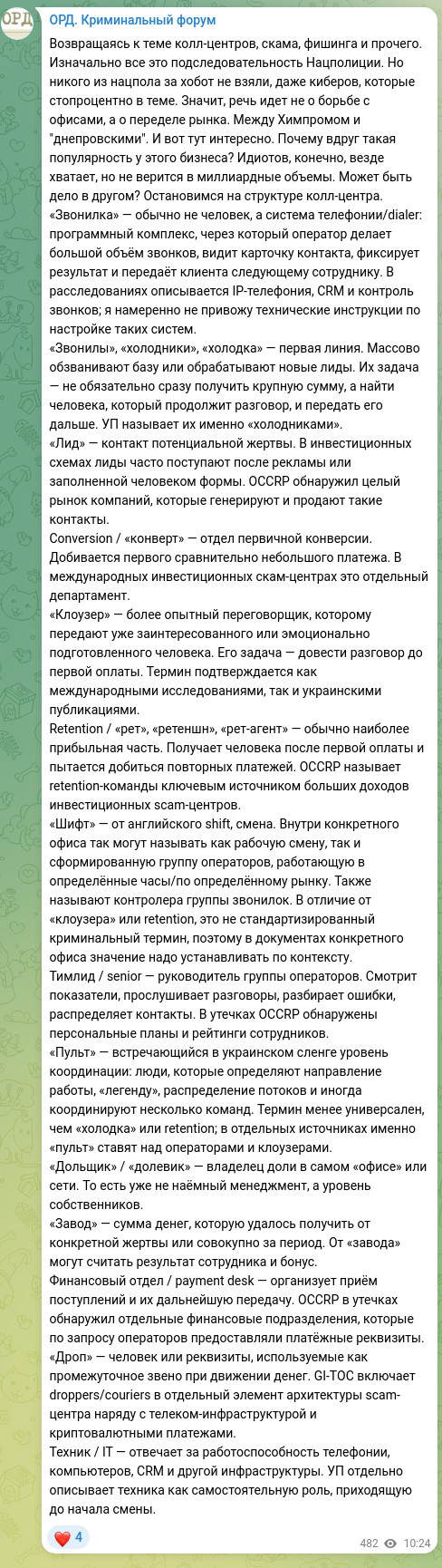
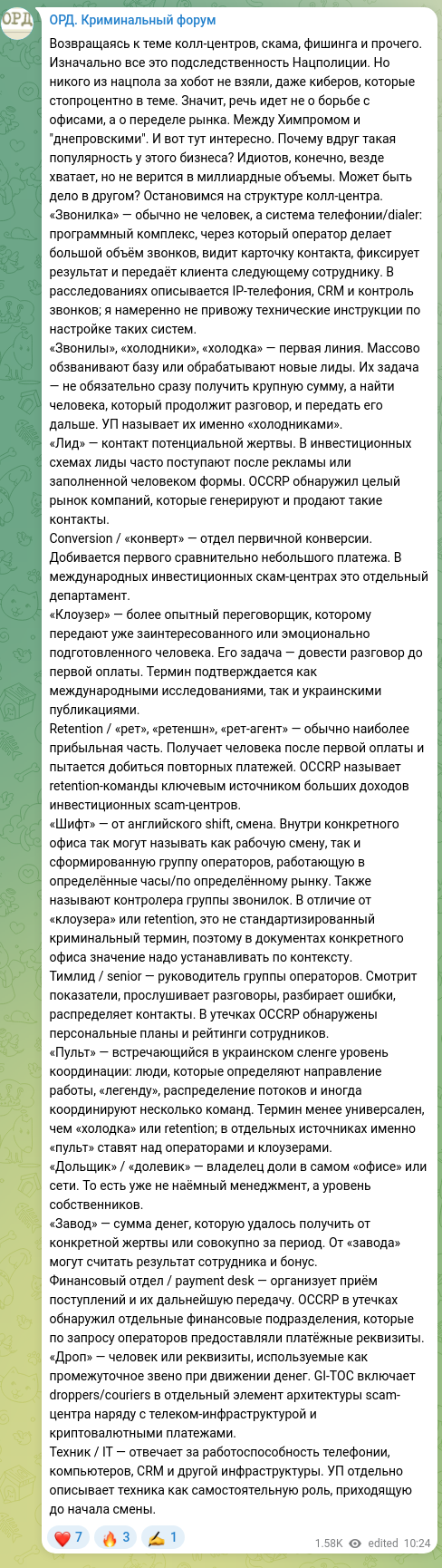
Returning to the topic of call centers, scams, phishing, and the like. Originally all of this was under the National Police’s jurisdiction. But nobody from the national police was taken by the scruff of the neck, not even the cyber units who are unquestionably involved. So this isn’t about fighting offices, it’s about dividing the market. Between Khimprom and the “Dnipro” group. And here it gets interesting. Why has this business suddenly become so popular? There are plenty of idiots everywhere, of course, but billion-dollar volumes are hard to believe. Maybe there’s another explanation? Let’s stop at the structure of a call center. The “dialer” — usually not a person but a telephony/dialer system: a software suite through which an operator makes a large volume of calls, sees the contact card, records the result, and passes the client to the next employee. Investigations describe IP telephony, CRM, and call monitoring; I deliberately do not provide technical instructions for configuring such systems.
“Callers,” “cold callers,” “cold line” — the first line. They mass-call a database or process new leads. Their task is not necessarily to get a large sum right away, but to find a person who will continue the conversation and hand them off. UP calls them precisely “cold callers.”
“Lead” — a contact of a potential victim. In investment schemes, leads often come from advertising or a form filled out by the person. OCCRP found a whole market of companies that generate and sell such contacts.
Conversion / “convert” — the initial conversion department. Secures the first relatively small payment. In international investment scam centers, this is a separate department.
“Closer” — a more experienced negotiator who is handed an already interested or emotionally primed person. Their task is to bring the conversation to the first payment. The term is supported by both international studies and Ukrainian publications.
Retention / “ret,” “retention,” “ret agent” — usually the most profitable part. Receives the person after the first payment and tries to obtain repeat payments. OCCRP calls retention teams a key source of large revenues for investment scam centers.
“Shift” — from English shift. Within a specific office they may use this to mean either a work shift or a formed group of operators working at certain hours/in a certain market. It’s also used for the controller of the calling group. Unlike “closer” or retention, this is not a standardized criminal term, so in a given office’s documents the meaning must be established from context.
Team lead / senior — the leader of a group of operators. Monitors metrics, listens to calls, analyzes mistakes, and distributes contacts. In OCCRP leaks personal targets and employee rankings were discovered.
“Control desk” — a coordination level found in Ukrainian slang: people who determine the direction of work, the “legend,” flow distribution, and sometimes coordinate multiple teams. The term is less universal than “cold line” or retention; in some sources the “control desk” is placed above operators and closers.
“Shareholder” / “stakeholder” — an owner of a share in the “office” or network. In other words, not hired management but the owners’ level.
“Plant” — the sum of money obtained from a particular victim or in total over a period. An employee’s result and bonus may be calculated from the “plant.”
Financial department / payment desk — organizes receipt of payments and their onward transfer. OCCRP leaks revealed separate financial subdivisions that provided payment details upon operators’ request.
“Drop” — a person or account used as an intermediary when moving money. GI-TOC includes droppers/couriers as a separate element of a scam center’s architecture alongside telecom infrastructure and cryptocurrency payments.
Technician / IT — responsible for the operation of telephony, computers, CRM, and other infrastructure. UP separately describes the technician as an independent role that arrives before the shift starts.







 Telegram publication