 Back
Back

Automatically translated version. May contain inaccuracies compared to the original.
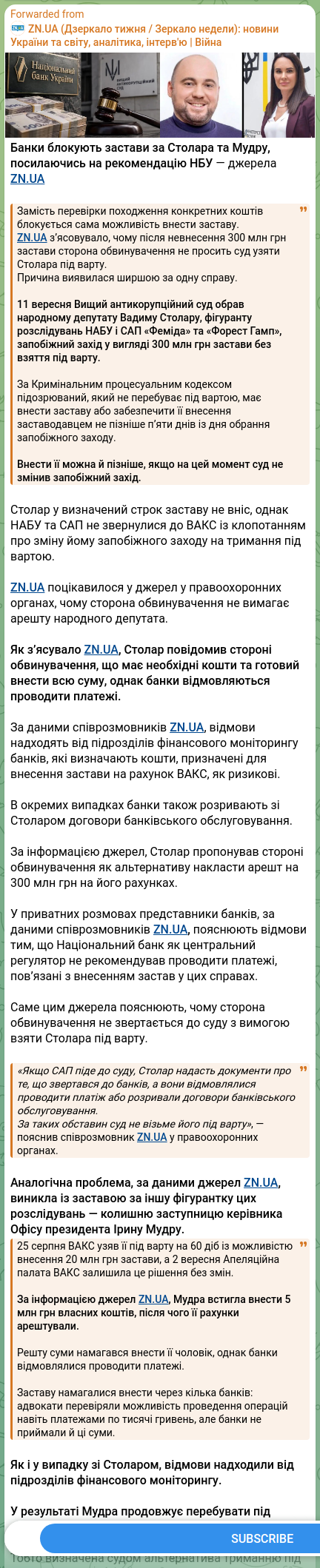
Banks are blocking the bail payments for Stolar and Mudra, citing an NBU recommendation — ZN.UA sources
Instead of verifying the origin of specific funds, the very possibility of posting bail is being blocked.
ZN.UA investigated why, after the 300 million UAH bail was not paid, the prosecution did not ask the court to place Stolar in custody.
The reason turned out to be broader than a single case.
In September, the High Anti-Corruption Court set a preventive measure for Member of Parliament Vadym Stolar, a figure in the NABU and SAP investigations “Femida” and “Forest Gump,” in the form of 300 million UAH bail without taking him into custody. 11
Under the Criminal Procedure Code, a suspect who is not in custody must pay the bail or ensure its payment by a guarantor no later than five days from the day the preventive measure is imposed.
It can be paid later if the court has not changed the preventive measure by that time.
Stolar did not pay the bail within the prescribed time, but NABU and SAP did not apply to the HACC to change his preventive measure to detention.
ZN.UA asked sources in law enforcement why the prosecution does not demand the MP’s arrest.
As ZN.UA found out, Stolar informed the prosecution that he has the necessary funds and is ready to pay the full amount, but banks refuse to process the payments.
According to ZN.UA’s interlocutors, refusals come from banks’ financial monitoring units, which classify the funds intended to be deposited as bail into the HACC account as risky.
In some cases banks also terminate their service agreements with Stolar.
According to sources, Stolar offered the prosecution as an alternative to freeze 300 million UAH in his accounts.
In private conversations, bank representatives, according to ZN.UA’s sources, explain the refusals by saying that the National Bank, as the central regulator, did not recommend processing payments related to posting bail in these cases.
Sources say this is why the prosecution does not petition the court to place Stolar in custody.
“If SAP goes to court, Stolar will present documents showing that he contacted banks and they refused to process the payment or terminated the banking service agreements.
Under such circumstances the court will not detain him,” a law enforcement source told ZN.UA.
According to ZN.UA’s sources, a similar problem arose with the bail for another figure in these investigations — former Deputy Head of the Office of the President Iryna Mudra.
In August the HACC placed her in custody for 60 days with the option of posting 20 million UAH bail, and in September the HACC Appeals Chamber left that decision unchanged. 25 2
According to ZN.UA’s sources, Mudra managed to pay 5 million UAH of her own funds, after which her accounts were frozen.
Her husband tried to pay the remaining amount, but banks refused to process the payments.
They attempted to pay the bail through several banks: lawyers checked the possibility of making transfers even by amounts of one thousand hryvnias, but banks did not accept these payments either.
As in Stolar’s case, refusals came from financial monitoring units.
As a result, Mudra remains in custody, although the court provided for her release after the bail was posted.
Thus the court-defined alternative to detention cannot practically be implemented due to the inability to execute a bank payment.
“Funds need to be verified. If they are legal and their origin is confirmed — the payment must be processed. You cannot, instead of carrying out a verification, simply block the very possibility of posting bail,” a ZN.UA source explained.
According to ZN.UA’s sources, in both cases the problem is the same — manual interference in the operation of financial monitoring: previously it could be used to circumvent controls, now — to block payments regardless of the funds’ origin.
🚀Support🤝_✅✅_🤝
🚀Join ZN.UA





 Telegram publication