Back
Back

Automatically translated version. May contain inaccuracies compared to the original.
📰 Financial Times wrote a major article on NABU’s tenth anniversary.
In short: over ten years the Bureau has become a force to be reckoned with. More than 60 MPs (not only current ones) are under investigation, the Prosecutor General resigned after the call-center cases. The Head of the Office of the President, ministers, and heads of central executive bodies are under suspicion.
And last year’s attempt by the authorities to subordinate NABU only strengthened the Bureau.
💁♂️There is also a sentence saying that “some deputies” accuse the Bureau of politicizing cases — and that NABU rejects these accusations.
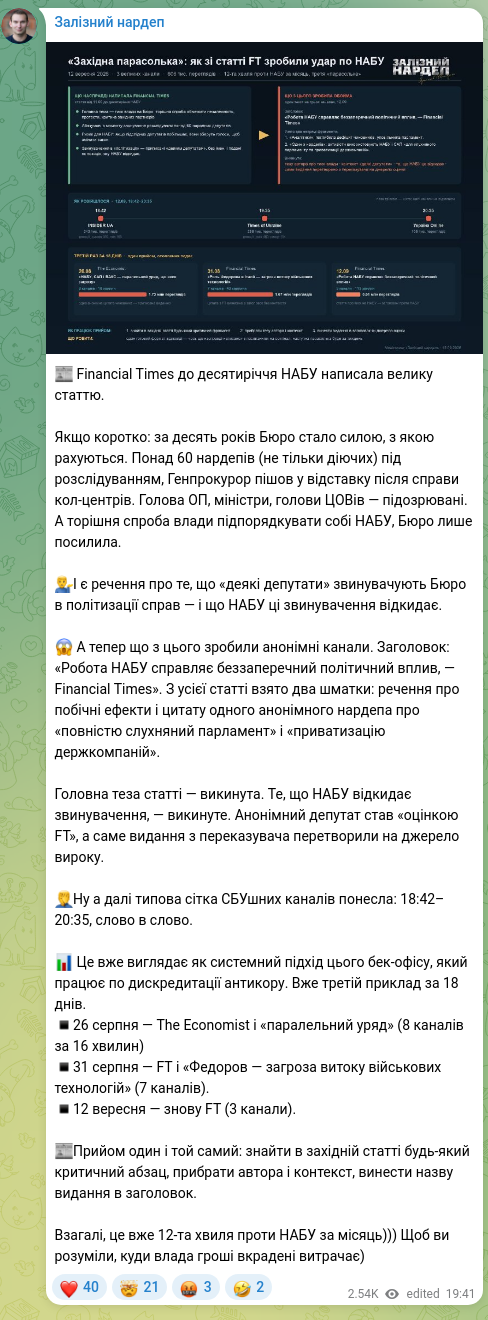
😱 Now see what anonymous channels made of this. Headline: “NABU’s work exerts indisputable political influence, — Financial Times.” From the entire article they took two fragments: the sentence about side effects and a quote from one anonymous MP about a “fully compliant parliament” and the “privatization of state companies.”
The main thesis of the article is omitted. The fact that NABU rejects the accusations — omitted. The anonymous deputy became an “FT assessment,” and the publication itself was turned by a reteller into the source of a verdict.
🤦♂️ Then the typical network of SBU channels ran with it: 18:42–20:35, word for word.
📊 This already looks like a systematic approach by that back office, which works to discredit the anti-corruption agency. The third example in 18 days.
▪️26 August — The Economist and the “parallel government” (8 channels in 16 minutes)
▪️31 August — FT and “Fedorov — a threat of military-technology leaks” (7 channels).
▪️12 September — again FT (3 channels).
📰The method is the same: find any critical paragraph in a Western article, remove the author and context, and put the publication’s name in the headline.
In general, this is already the 12-th wave against NABU this month))) So you understand where the authorities are spending the money they stole)






 Telegram publication