Back
Back

Automatically translated version. May contain inaccuracies compared to the original.
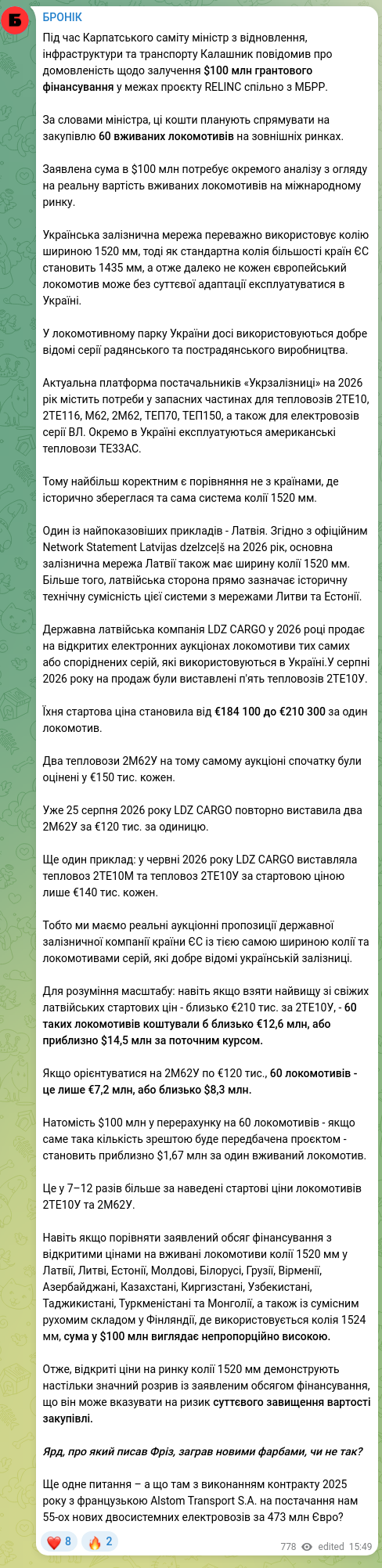
During the Carpathian Summit, the minister of Restoration, Infrastructure, and Transport Kalashnyk reported an agreement to secure $100 million in grant financing under the RELINC project jointly with the IBRD.
According to the minister, these funds are planned to be directed toward the purchase of 60 used locomotives on foreign markets.
The declared amount of $100 million requires separate analysis in view of the real cost of used locomotives on the international market.
Ukraine’s railway network primarily uses track gauge of 1520 mm, while the standard gauge in most EU countries is 1435 mm, so not every European locomotive can be operated in Ukraine without significant adaptation.
Well-known series of Soviet and post-Soviet production are still used in Ukraine’s locomotive fleet.
The current supplier platform of Ukrzaliznytsia for 2026 includes needs for spare parts for diesel locomotives 2TE10, 2TE116, M62, 2M62, TEP70, TEP150, as well as for electric locomotives of the VL series. Separately, American diesel locomotives TE33A are operated in Ukraine.
Therefore the most correct comparison is not with countries where the same track gauge 1520 mm historically remained.
One of the most illustrative examples is Latvia. According to the official Network Statement Latvijas dzelzceļš for 2026, Latvia’s main railway network also has a track gauge of 1520 mm. Moreover, the Latvian side explicitly states the historical technical compatibility of this system with the networks of Lithuania and Estonia.
The state Latvian company LDZ CARGO in 2026 is selling at open electronic auctions locomotives of the same or related series that are used in Ukraine. In August 2026, five 2TE10U diesel locomotives were put up for sale.
Their starting prices ranged from €184 100 to €210 300 per locomotive.
Two 2M62U diesel locomotives at the same auction were initially priced at €150 thousand each.
Already on 25 August 2026 LDZ CARGO re-listed two 2M62U for €120 thousand per unit.
Another example: in June 2026 LDZ CARGO listed a 2TE10M and a 2TE10U diesel locomotive with a starting price of only €140 thousand each.
So we have real auction offers from the state railway company of an EU country with the same track gauge and locomotive series that are well known to the Ukrainian railway.
To understand the scale: even if we take the highest of the recent Latvian starting prices—about €210 thousand for a 2TE10U—60 such locomotives would cost about €12,6 million, or approximately $14,5 million at the current exchange rate.
If we base on 2M62U at €120 thousand, 60 locomotives would be only €7,2 million, or about $8,3 million.
Meanwhile $100 million converted to 60 locomotives—if that is ultimately the number provided for by the project—amounts to approximately $1,67 million per used locomotive.
That is 7–12 times higher than the cited starting prices for 2TE10U and 2M62U locomotives.
Even if the declared financing is compared with open prices for used locomotives of 1520 mm gauge in Latvia, Lithuania, Estonia, Moldova, Belarus, Georgia, Armenia, Azerbaijan, Kazakhstan, Kyrgyzstan, Uzbekistan, Tajikistan, Turkmenistan, and Mongolia, as well as compatible rolling stock in Finland, where a 1524 mm gauge is used, the sum of $100 million looks disproportionately high.
Thus, open market prices for 1520 mm gauge demonstrate such a significant gap with the declared financing that it may indicate a risk of substantial overstatement of procurement costs.
The yard Friz wrote about has taken on new colors, hasn't it?
One more question – what about the execution of the 2025 contract year with French Alstom Transport S.A. for the supply to us of 55 new two-system electric locomotives for 473 million euros?






 Telegram publication