Back
Back
Automatically translated version. May contain inaccuracies compared to the original.
⚙️🕵️♂️🕵️♂️🕵️♂️🕵️♂️🕵️♂️🕵️♂️🕵️♂️
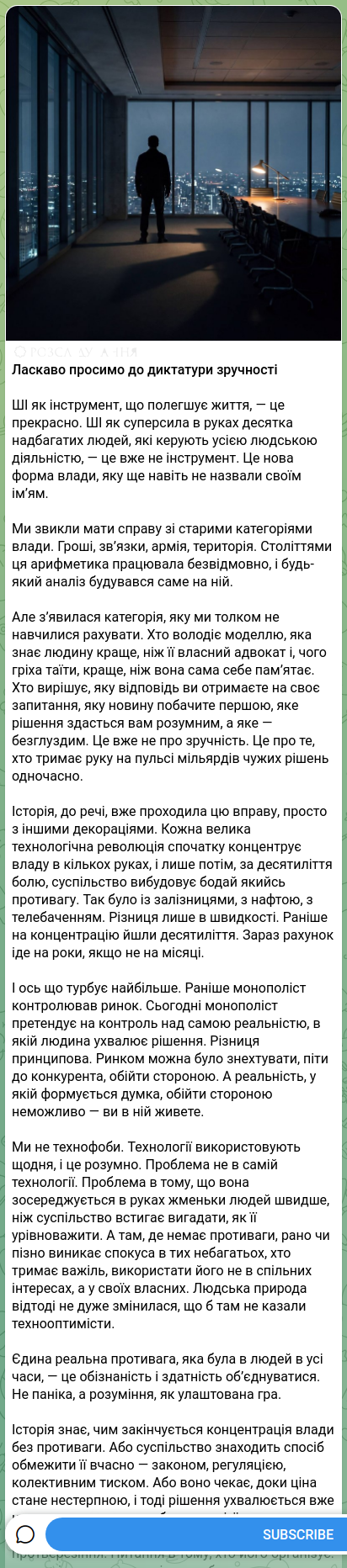
Welcome to the dictatorship of convenience
AI as a tool that makes life easier is wonderful. AI as a superpower in the hands of a dozen ultra-wealthy people who manage all human activity is no longer a tool. It is a new form of power, not yet even named.
We are used to dealing with old categories of power: money, connections, army, territory. For centuries this arithmetic worked reliably, and any analysis was built on it.
But a category has appeared that we have not yet learned to measure. Who owns the model that knows a person better than their own lawyer and, truth be told, better than they remember themselves. Who decides what answer you will receive to your question, which news you will see first, which decision will seem reasonable to you and which absurd. This is no longer about convenience. This is about who keeps a hand on the pulse of billions of other people's decisions simultaneously.
History, by the way, has already run this exercise, just with different scenery. Each major technological revolution first concentrates power in a few hands, and only later, after decades of pain, does society build some counterbalance. It was so with railways, with oil, with television. The only difference is speed. Before, concentration took decades. Now the clock is in years, if not months.
And here is what worries most. Previously a monopolist controlled the market. Today a monopolist claims control over the very reality in which a person makes decisions. The difference is fundamental. You could ignore a market, go to a competitor, work around it. But you cannot avoid the reality in which opinion is formed—you live in it.
We are not technophobes. Technologies are used daily, and that is sensible. The problem is not the technology itself. The problem is that it concentrates in the hands of a handful of people faster than society can come up with ways to balance it. And where there is no counterbalance, sooner or later those few who hold the lever will be tempted to use it not in the common interest but in their own. Human nature hasn't changed that much since then, whatever the techno-optimists say.
The only real counterbalance people have had at all times is awareness and the ability to come together. Not panic, but understanding how the game is played.
History knows how the concentration of power without a counterbalance ends. Either society finds a way to limit it in time—by law, regulation, collective pressure—or it waits until the price becomes unbearable, and then the decision is made not peacefully but by the collapse of the whole system at once. The question is not whether a sobering moment will come. The question is who will organize it: sensible people in advance, or circumstances too late.
And what do you think: does the concentration of power around AI personally worry you, or is it exaggerated panic from people who don't understand technology?
💬 ABleaks_bot
💕 Join








 Telegram publication