Back
Back
Automatically translated version. May contain inaccuracies compared to the original.
⚡️ LAWSUIT AGAINST THE ILLEGAL APPOINTMENT OF KOVALSKYI RECEIVES SUBSTANTIAL EXPERT CONFIRMATION
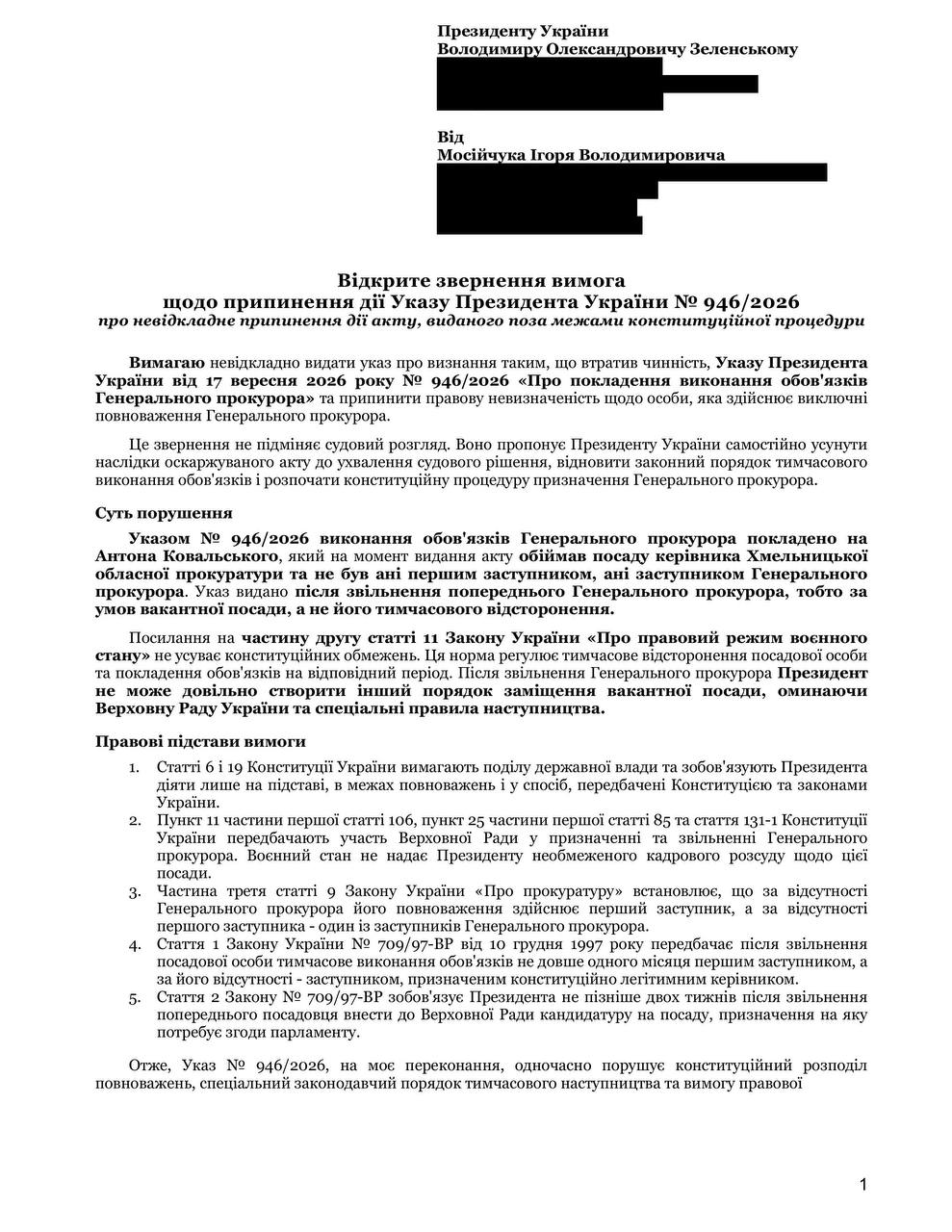
22 September — Ihor Mosiychuk filed a lawsuit with the Cassation Administrative Court within the Supreme Court against the President of Ukraine, Volodymyr Zelensky.
The lawsuit asks to declare unlawful and invalid Presidential Decree No. 946/2026, by which Anton Kovalskyi, head of the Khmelnytskyi regional prosecutor’s office, was assigned to perform the duties of the Prosecutor General.
Our legal position is based on several key circumstances.
🔹 The Constitution does not grant the President the right to unilaterally appoint an acting Prosecutor General.
🔹 The second part of Article 11 of the Law “On the Legal Regime of Martial Law,” which Zelensky cited, provides for a temporary replacement only for the period of suspension of an official.
However, Ruslan Kravchenko had already been finally dismissed at the time of Kovalskyi’s appointment. Therefore, no “relevant period of suspension” existed anymore.
🔹 In the absence of the Prosecutor General, his powers under the law should be exercised by the first deputy, and in his absence — by one of the deputies.
Kovalskyi was neither the first deputy nor a deputy Prosecutor General. At the time the Decree was issued, he headed the Khmelnytskyi regional prosecutor’s office.
🔹 The illegal appointment directly violated the plaintiff’s rights. Ihor Mosiychuk submitted a statement to the acting Prosecutor General about a possible criminal offense by People’s Deputy Serhii Labaziuk.
According to Articles 482-2 of the Criminal Procedure Code of Ukraine, only the Prosecutor General or a person lawfully performing his duties can enter such information into the Unified Register of Pre-Trial Investigations.
And now the crucial point.
The influential independent analytical center — the Center for Political and Legal Reforms — published its own legal analysis and independently reached practically the same conclusions.
The CPPR experts stated directly:
The President of Ukraine appointed an acting Prosecutor General in an unconstitutional manner.
The CPPR confirms that:
▪️ The Constitution does not grant the President the corresponding authority;
▪️ Article 11 of the Law on Martial Law cannot be applied to the office of the Prosecutor General in this way;
▪️ after Kravchenko’s dismissal the President could not use the mechanism intended for temporary suspension;
▪️ the duties of the Prosecutor General should have been performed by the first deputy or one of the deputies, not a regional prosecutor;
▪️ Kovalskyi’s decisions made within the exclusive powers of the Prosecutor General may be called into question;
▪️ Decree No. 946/2026 may be annulled by the Supreme Court as unlawful.
Moreover, the CPPR refers to a special Law No. 709/97-VR, according to which the duties of a dismissed official are temporarily performed precisely by the first deputy, and in his absence — by a deputy.
Thus, the position of our lawsuit is now supported not only by the norms of the Constitution, the Law “On the Prosecutor’s Office” and the Criminal Procedure Code of Ukraine, but also by the independent conclusion of one of Ukraine’s leading expert centers in constitutional law and criminal justice.
The CPPR is not a party to our case and did not formally “support” the filed lawsuit. But its experts independently examined the situation and in fact confirmed its key legal construction.
So now this is no longer just the position of a single plaintiff.
This is a formed public legal opinion: the President exceeded his constitutional powers, bypassed parliament and the legally established procedure for filling the office of the Prosecutor General.
Now the word is with the Supreme Court.
Will it stand up for the Constitution, or will it try to legalize a dangerous precedent under which the President during martial law can unilaterally appoint the head of the prosecutor’s office bypassing the Verkhovna Rada and the relevant legislation?
The case is no longer just about Kovalskyi.
The case is about whether the Constitution continues to operate in Ukraine.
🔗 Position of the Center for Political and Legal Reforms







 Telegram publication