Back
Back
Automatically translated version. May contain inaccuracies compared to the original.
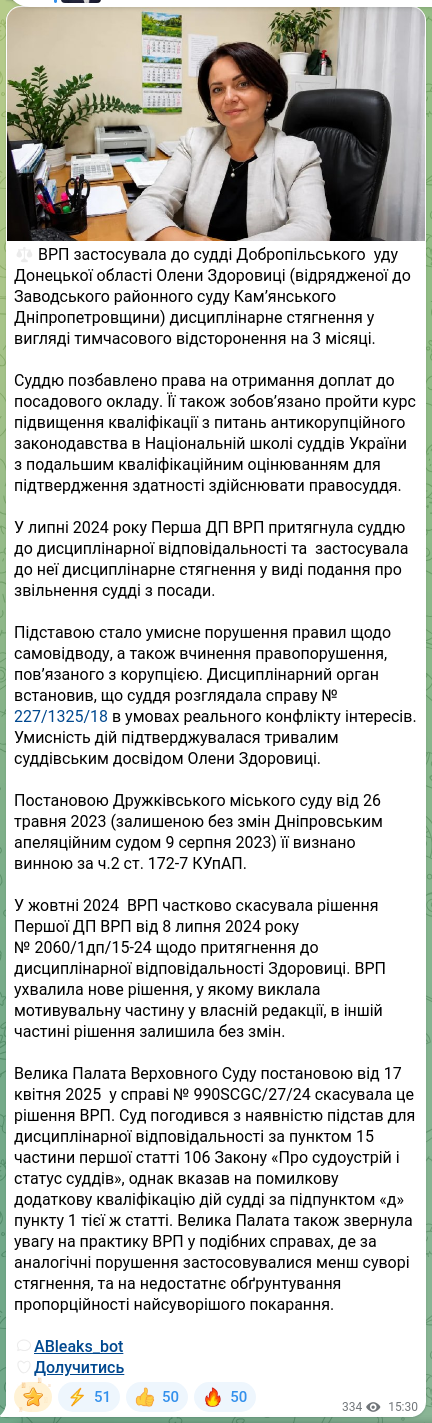
⚖️ The High Council of Justice imposed a disciplinary sanction on judge Olena Zdorovytsia of the Dobropilskyi district court in Donetsk region (seconded to the Zavodske District Court of Kamianske, Dnipropetrovsk region) in the form of temporary suspension for 3 months.
The judge was deprived of the right to receive salary supplements. She was also required to complete a professional development course on anti-corruption legislation at the National School of Judges of Ukraine, followed by a qualification assessment to confirm her ability to administer justice.
In July 2024 the First Disciplinary Panel of the High Council of Justice held the judge disciplinarily liable and applied to her the disciplinary sanction of a submission for the judge’s dismissal from office.
The grounds were intentional violation of the rules on self-recusal, as well as committing an offense related to corruption. The disciplinary body found that the judge heard case No. 227/1325/18 while in a real conflict of interest. The intentional nature of the actions was supported by Olena Zdorovytsia’s lengthy judicial experience.
By the ruling of Druzhkivka City Court dated 26 May 2023 (upheld without changes by the Dnipro Court of Appeal on 9 August 2023) she was found guilty under part 2 of article 172-7 of the Code of Ukraine on Administrative Offenses.
In October 2024 the High Council of Justice partially annulled the decision of the First Disciplinary Panel of the High Council of Justice dated 8 July 2024, year No. 2060/1dp/15-24 concerning bringing Zdorovytsia to disciplinary responsibility. The High Council adopted a new decision, in which it rephrased the reasoning section in its own wording, and left the rest of the decision unchanged.
The Grand Chamber of the Supreme Court, by ruling dated 17 April 2025 in case No. 990SCGC/27/24, annulled that decision of the High Council of Justice. The Court agreed that there were grounds for disciplinary liability under paragraph 15 of part one of article 106 of the Law “On the Judiciary and the Status of Judges,” but pointed to an erroneous additional qualification of the judge’s actions under subparagraph “d” of paragraph 1 of the same article. The Grand Chamber also noted the High Council’s practice in similar cases, where less severe sanctions were applied for comparable violations, and the insufficient justification of the proportionality of the harshest punishment.
💬ABleaks_bot
💕Join





 Telegram publication