
 Back
Back

Automatically translated version. May contain inaccuracies compared to the original.
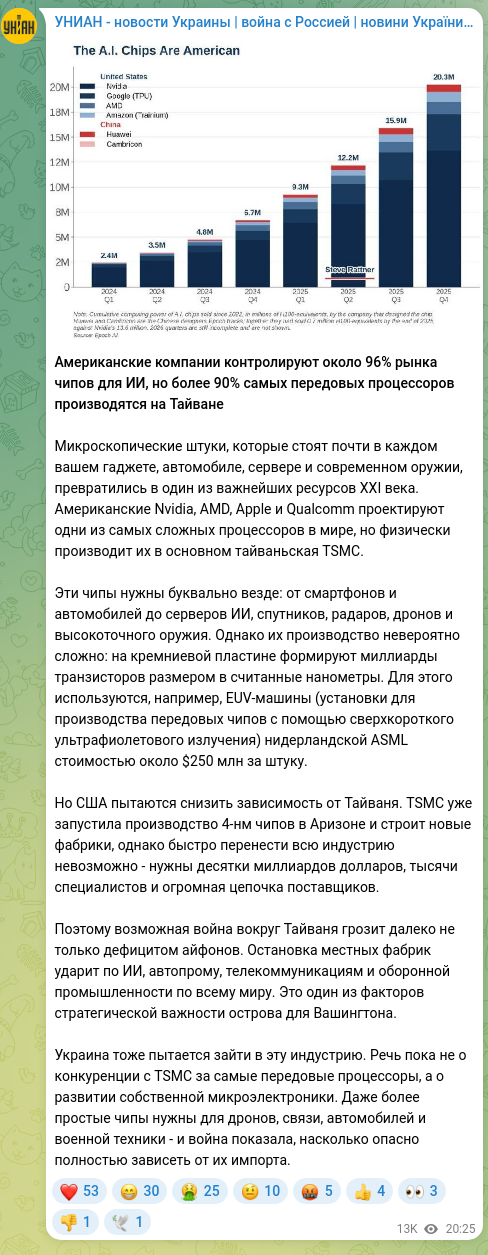
American companies control about 96% of the AI chip market, but more than 90% of the most advanced processors are produced in Taiwan
The microscopic things that sit in almost every gadget, car, server, and modern weapon have become one of the most important resources of the 21st century. American companies Nvidia, AMD, Apple, and Qualcomm design some of the world's most complex processors, but they are physically manufactured mainly by Taiwan's TSMC.
These chips are needed literally everywhere: from smartphones and cars to AI servers, satellites, radars, drones, and precision weapons. However, their production is incredibly complex: billions of transistors just a few nanometers in size are formed on a silicon wafer. For this, for example, EUV machines (equipment for producing advanced chips using extreme ultraviolet radiation) from the Netherlands' ASML are used, costing about $250 million apiece.
But the United States is trying to reduce its dependence on Taiwan. TSMC has already started producing 4-nm chips in Arizona and is building new fabs, but it is impossible to quickly move the entire industry — it requires tens of billions of dollars, thousands of specialists, and a huge supplier chain.
Therefore, a possible war over Taiwan threatens far more than just an iPhone shortage. A halt to local fabs would hit AI, the auto industry, telecommunications, and defense industries worldwide. This is one of the factors behind the island's strategic importance to Washington.
Ukraine is also trying to enter this industry. The discussion so far is not about competing with TSMC for the most advanced processors, but about developing its own microelectronics. Even simpler chips are needed for drones, communications, cars, and military equipment — and the war has shown how dangerous it is to be completely dependent on imports.






 Telegram publication