Back
Back

Automatically translated version. May contain inaccuracies compared to the original.
About Umierov and more: reflections on the personnel policy of recent years. Impressions without definitive answers.
Rustem Umierov will head the Foreign Intelligence Service of Ukraine (SZRU). In fact, this was planned back when Umierov was head of the State Property Fund. However, in 6 September 2023 he was, by a constitutional majority (that is, more than 300 votes, which allows changing the Constitution), elected minister of defense by 338 people's deputies. Only Stepan Poltorak received more votes in 2 December 2014 — 347 votes. Why? Because practically all factions voted for these two ministers: both the majority and the opposition.
Umierov entered the Verkhovna Rada of Ukraine (VRU) from Holos together with Vakarchuk. He has friendly relations with MP Ustinova, who still covers for him. Back then Ustinova, who comes from the Anti-Corruption Action Center (AntAC), persuaded both the VRU and various civic activists and figures to support Rustem. Supposedly, he would be the best minister of defense.
The opposition voted and rejoiced that during the full-scale war a key direction—defense—would be led NOT by a representative of Servant of the People. Also, given that the Armed Forces were then led by Zaluzhny, who was already eyeing political bonuses, the cunning plan to present the President together with his Cabinet and parliamentary majority as outsiders—whose Minister of Defense and Commander-in-Chief are “not theirs,” and who are “saving” the state while those in power “sell it out”—looked almost perfect. So the rocking increased. But Zelensky took that step and put forward Umierov—a reputational compromise figure for everyone.
And...
Rustem Enverovych surprised. Once in the Ministry of Defense, he proved to be an unprincipled, chaotic, and secretive leader, and very quickly switched his colors to the authorities.
The opposition was disappointed, civic activists cried. Those who had so aggressively elevated him to the heights of political reputation, destroying the reputation of his predecessor Reznikov, now set about mercilessly destroying Umierov as well. The anti-corruption community targeted the search for schemes, and Ustinova quarreled with her civic roots and finally fell under Yermak's influence.
Thus two years passed. Umierov was mercilessly taken down; he increasingly “served.” Managerial chaos developed in the Ministry of Defense, to the point that during Rustem Enverovych's tenure the ministry even acquired the nickname “minchaos” — the ministry of chaos.
Syrskyi, who came after Zaluzhny, successfully exploited the weak supervisory function of the Ministry of Defense and built his own vertical of unlimited power in the troops without control. The decisive step that nullified the ministry's role was the dismissal of the Ministry of Defense’s chief inspector, General Voronchenko, an inspector who refused to keep silent. This was done at Syrskyi's insistence, and Umierov quickly signed everything.
But the chaos in the ministry grew, as did the pressure from anti-corruption bodies, which both through leaks to journalists, bloggers, and deputies, and directly, made it clear that Umierov would be a subject of investigation and should receive a suspicion notice along with Yermak.
So finally the decision was made to replace him with the most experienced neutral manager available to the President — former Prime Minister Denys Shmyhal. But such a valuable loyal cadre, who was also being tormented by those pesky anti-corruption bodies, could not just be thrown out. So, in order not to lose him and despite his tendency toward chaos, he was given the post of Secretary of the National Security and Defense Council (RNBO).
The infighting continued. The country went through “Mindichgate,” and the question arose where to put still our own, but overly ambitious and stubborn Fedorov, who dared to help anti-corruption activists, was the most active in the coalition against Yermak, and now claimed he should head the Office of the President or the government. He also constantly emphasized the war plan, overseeing a number of defense projects that in practice went beyond the powers of his position as the country's digital manager.
Well, by playing a little on Mykhailo Albertovych's ambitions with promises of carte blanche in the war, he was persuaded to head the Ministry of Defense. And Shmyhal was moved to energy, despite his wishes, cutting short the initiated ordering of the ministry after Umierov's chaos.
Since Syrskyi's godfather, General Ivashchenko, who had been appointed earlier to the SZRU and whom Syrskyi had long been trying to pull into the GUR of the Ministry of Defense, was indeed redirected instead of Budanov to the GUR of the Ministry of Defense, the SZRU thereafter was practically left without management.
Indeed, Fedorov was driven into a trap. The GUR of the Ministry of Defense was given to Syrskyi's godfather; Syrskyi himself and Hnatov (the Chief of the General Staff) were not going to be dismissed, and Fedorov was not approved for any personnel decisions in the troops except one — Yelyzarov “Lazar” (and that only initially, publicly).
The trap closed. It remained only to wait how events would unfold according to one of two scenarios: either Mykhailo would remain a friendly digitalizer and continue to add bonuses by digitizing and prettily presenting the shell under which “Skelia,” the busification, and lies at the front would continue to operate — Syrskyi's system, for which no alternative was seen (and this also has some truth, since it is unknown how the front would hold up without his methods), or he would try to dig deep, and then “Skelia,” the busification, and lies at the front would destroy his reputation, lower the ratings, and the minister—“given so many opportunities and having failed”—could be dismissed.
It didn't happen exactly as expected, and several factors contributed: Fedorov decided to fight and increasingly interfered in military affairs, entering into a harsh conflict with Syrskyi, procurement officers (but there the story is more complicated; I do not idealize either side), and, most importantly, Mykhailo became involved in the struggle over the war plan—over how we fight and how we should defeat Russia.
And Umierov couldn't even handle the basic functioning of the RNBO, yet he actively operated on negotiation platforms. At the same time, anti-corruption bodies failed to form a suspicion against Umierov, not finding enough evidence of his corrupt activity, partly because he didn't even manage to organize the proposed corrupt schemes :) Or he cleverly maneuvered and didn't support them.
Because, in my observations, Rustem Enverovych skillfully pretends to be much dumber and more indulgent than he really is. In reality, he is one of the smartest men I have met. He is a strong negotiator in a specific manner uncharacteristic for our culture, and he has extensive connections in the Middle East — to the point that one wonders whose interests he lobbies.
I believe he is indeed chaotic in organization and does not pull together management of large systems. And here's what's interesting: given the situation with the intelligence services in the country and his talents and connections, if back then, in 2023 he had been redirected to the SZRU, perhaps that would have been a good decision. “Rewind” my story and imagine what another reality might have looked like. Would we have had a more stable Ministry of Defense, fewer internal fights, preserved reputations of many people, better ties between the authorities and the opposition, and much more? Could the SZRU situation have been better? Maybe...
Perhaps he would not only then but now be a good head of the SZRU. The Foreign Intelligence Service is in deep decline. Potentially the country's main external special service (and not the GUR of the Ministry of Defense, which has taken on some inappropriate functions) practically does not exist. If you add Umierov's negotiation skills to this, it could be a plus.
But overall the whole situation looks... Draw your own conclusions.
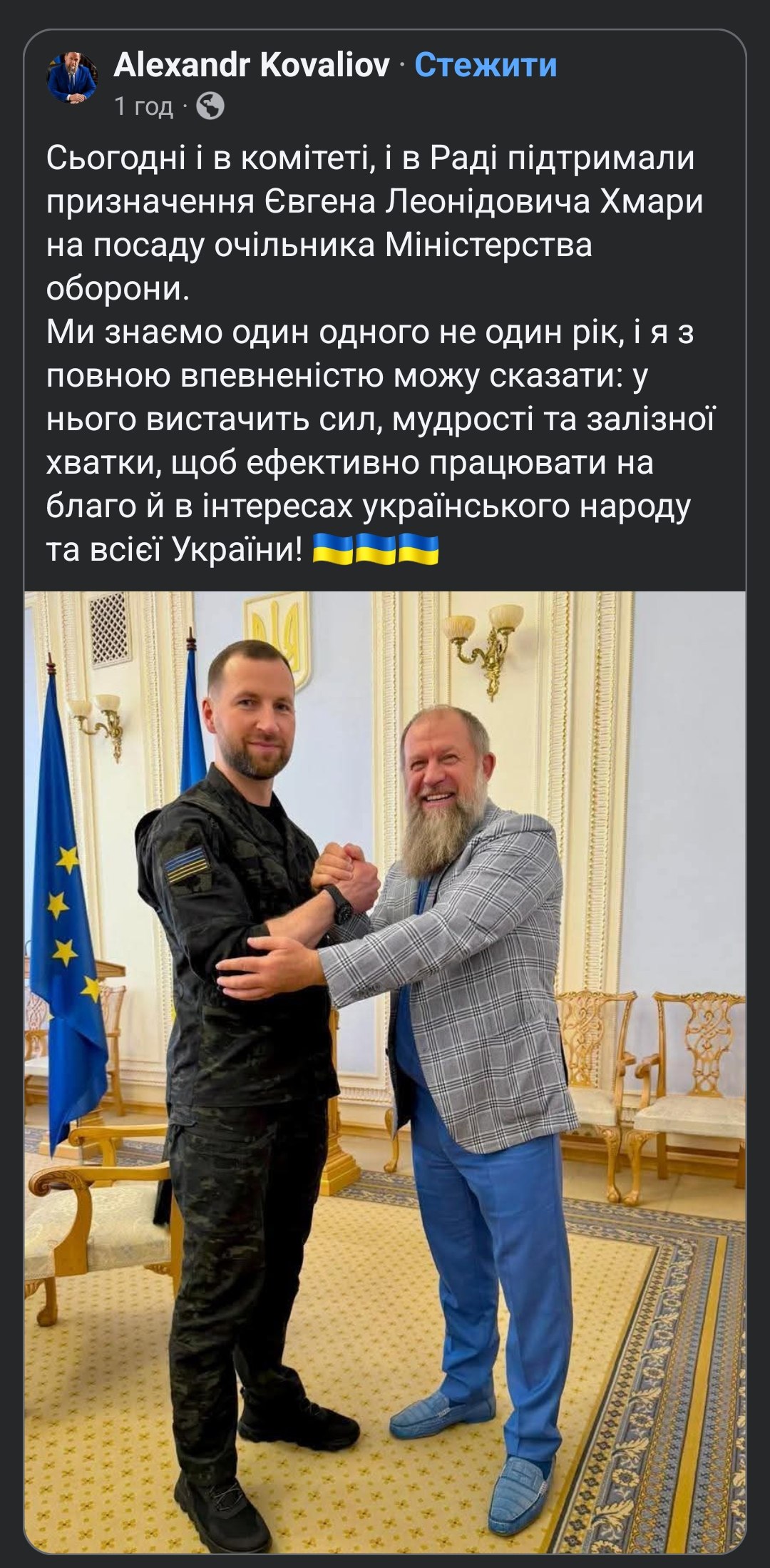
Personally, I am sorry that one could still hope that Khmar would be redirected to the SZRU from the Ministry of Defense and Fedorov returned. But now it's clear that Zelensky increasingly does not want to return Fedorov, and Khmar could be put up for a vote as soon as the next parliamentary week.
For the Ministry of Defense this is likely a real catastrophe. Another one.
My own mistake, I believe, was trusting the anti-corruption movement too much in evaluating ministers. When they called to attack ministers, I joined in, although I should have delved more into why Reznikov was attacked, Umierov praised, and then Umierov attacked. Despite all Reznikov's shortcomings, if there had been the same minister of defense for the entire period of the full-scale invasion, perhaps the state of the ministry and the armed forces would have been better? Maybe. Or not. Maybe frequent ministerial changes prevented processes from solidifying and contributed to development?
There are no simple answers, no black-and-white.
That's the situation.