Back
Back
Automatically translated version. May contain inaccuracies compared to the original.
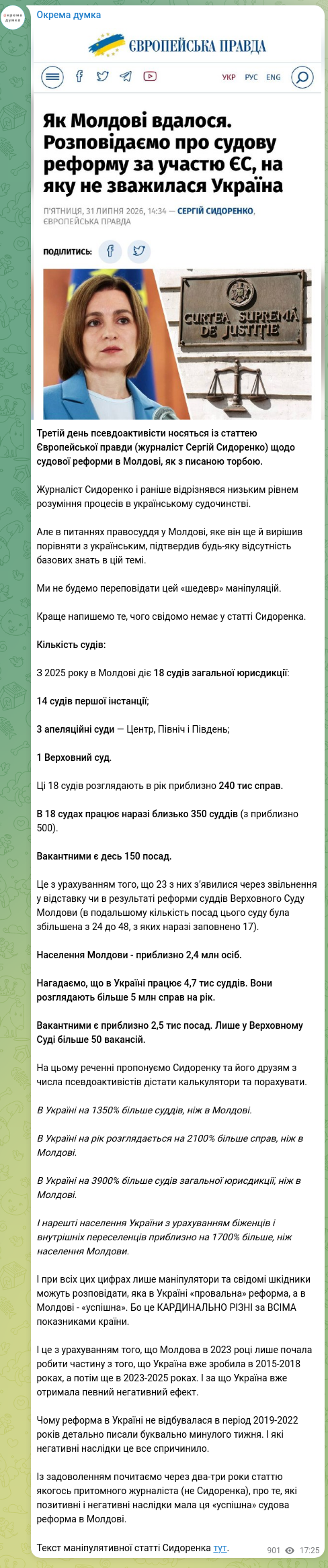
For the third day pseudo-activists have been parading around an article in European Truth (journalist Serhiy Sydorenko) about judicial reform in Moldova like it’s a holy relic.
Journalist Sydorenko has previously been distinguished by a low level of understanding of processes in Ukrainian jurisprudence.
But on matters of justice in Moldova, which he even decided to compare with Ukraine’s, he confirmed any lack of basic knowledge on the subject.
We will not retell this “masterpiece” of manipulation.
Instead we will write what is consciously missing from Sydorenko’s article.
Number of courts:
Since 2025 Moldova has had 18 courts of general jurisdiction:
14 courts of first instance;
3 appellate courts — Center, North, and South;
1 Supreme Court.
These 18 courts consider approximately 240 thousand cases per year.
About 350 judges currently work in 18 courts (out of approximately 500).
About 150 positions are vacant.
This takes into account that 23 of them appeared due to resignations or as a result of the reform of the judges of the Supreme Court of Moldova (subsequently the number of positions at that court was increased from 24 to 48, of which 17 are currently filled).
The population of Moldova is approximately 2,4 million people.
Recall that in Ukraine 4,7 thousand judges work. They consider more than 5 million cases per year.
About 2,5 thousand positions are vacant. Only in the Supreme Court there are more than 50 vacancies.
At this sentence we suggest Sydorenko and his friends among the pseudo-activists get their calculators out and do the math.
Ukraine has 1350% more judges than Moldova.
Ukraine handles 2100% more cases per year than Moldova.
Ukraine has 3900% more courts of general jurisdiction than Moldova.
And finally, taking into account refugees and internally displaced persons, Ukraine’s population is approximately 1700% larger than Moldova’s.
And with all these figures only manipulators and deliberate saboteurs can say that Ukraine’s reform is “failed” while Moldova’s is “successful.” Because these are FUNDAMENTALLY DIFFERENT countries by ALL indicators.
And this is taking into account that Moldova in 2023 only began to do part of what Ukraine had already done in 2015–2018, and then again in 2023–2025. And for which Ukraine has already experienced some negative effects.
Why the reform in Ukraine did not take place during 2019–2022 was written about in detail literally last week. And what negative consequences all of this caused.
We will gladly read in two to three years an article by some reasonable journalist (not Sydorenko) about what positive and negative consequences this “successful” judicial reform in Moldova had.
Sydorenko’s manipulative article is here.