Back
Back
Automatically translated version. May contain inaccuracies compared to the original.
⚙️ “Leak” of the Vyriy Industries case — what is happening?
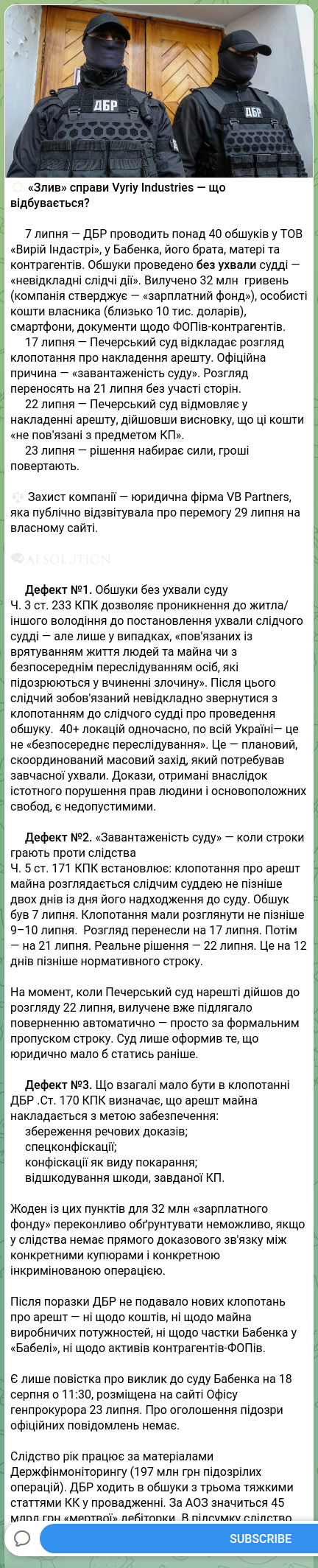
🔸7 July — the State Bureau of Investigations (DBR) conducts more than 40 searches at LLC Vyriy Industry, at Babenko’s, his brother’s, his mother’s, and contractors’ premises. Searches were carried out without a judge’s warrant — “urgent investigative actions.” Seized were 32 million hryvnias (the company says it was a “payroll fund”), the owner’s personal cash (about 10 thousand dollars), smartphones, and documents related to sole proprietor contractors.
🔸17 July — Pechersky Court postpones consideration of the motion to impose an arrest. Official reason — “court backlog.” The hearing is moved to 21 July without the parties’ participation.
🔸22 July — Pechersky Court refuses to impose the arrest, concluding that these funds are “not related to the subject of the criminal proceedings.”
🔸23 July — the decision takes effect, and the money is returned.
⚖️ The company’s defense is the law firm VB Partners, which publicly reported the victory on its own website on 29 July.
🧠🧡🧡🧡🧡🧡🧡
✔️Defect No. 1. Searches without a warrant
Part 3 of art. 233 of the Criminal Procedure Code allows entry into a residence/other premises before a judge’s warrant is issued — but only in cases “related to saving human lives and property or the immediate pursuit of persons suspected of committing a crime.” After that, the investigator is obliged to immediately apply to the investigating judge for an order to conduct the search. Simultaneous actions at 40+ locations across Ukraine are not an “immediate pursuit.” This is a planned, coordinated mass operation that required a prior warrant. Evidence obtained as a result of a substantial violation of human rights and fundamental freedoms is inadmissible.
✔️Defect No. 2. “Court backlog” — when deadlines work against the investigation
Part 5 of art. 171 of the Criminal Procedure Code establishes: a motion to arrest property must be considered by the investigating judge no later than two days from the day it is received by the court. The search took place on 7 July. The motions should have been considered no later than 9–10 July. The hearing was postponed to 17 July. Then — to 21 July. The actual decision — 22 July. That is 12 days later than the statutory deadline.
By the time Pechersky Court finally reached the hearing on 22 July, the seized funds were already due to be returned automatically — simply because the deadline had been formally missed. The court only formalized what legally should have happened earlier.
✔️Defect No. 3. What should have been in the DBR’s motion. Art. 170 of the Criminal Procedure Code defines that property arrest is imposed for the purpose of ensuring:
🔸preservation of physical evidence;
🔸special confiscation;
🔸confiscation as a form of punishment;
🔸compensation for damage caused by the criminal offense.
None of these points can be convincingly justified for the 32 million “payroll fund” unless the investigation has direct evidentiary linkage between the specific bills and a specific alleged operation.
After the DBR’s defeat, it did not file new motions for arrest — neither for the funds nor for the production assets, nor for Babenko’s share in Babel, nor for the assets of contractor sole proprietors.
There is only a summons for Babenko to appear in court on 18 August at 11:30, posted on the Office of the Prosecutor General’s website on 23 July. There are no official announcements of a notification of suspicion.
The investigation has been working for a year based on materials from the State Financial Monitoring Service (197 million hryvnias of suspicious transactions). The DBR conducts searches under three serious criminal code articles in the proceedings. The AOZ lists 45 billion hryvnias of “dead” receivables. In the end, the investigation could not convince the court to arrest even the seized money.
Under the current configuration, case No. 42025000000000468 has three possible scenarios:
🔸Scenario “soft leak” — after political changes the proceeding quietly moves into a suspension stage under para. 3 part 1 art. 280 of the Criminal Procedure Code (“the person who committed the criminal offense was not identified”) — and it ends up in the archive.
🔸Scenario “show trial” — a new defense minister will receive the order to “close” the case with the issuance of specific charges.
🔸Scenario “dilution” — the case will be merged with other criminal proceedings on AOZ, stretched out over dozens of episodes, and in the overall flow of the 45-billion gap it will become a statistical unit.
⚖️The most likely is scenario “A.” Because when an investigation after 15 days cannot prove even the obvious to a district court — this is not about legal complexity. It is about a lack of political will to see the case through to the end.
💬 ABleaks_bot
💕 Join