Back
Back
Automatically translated version. May contain inaccuracies compared to the original.
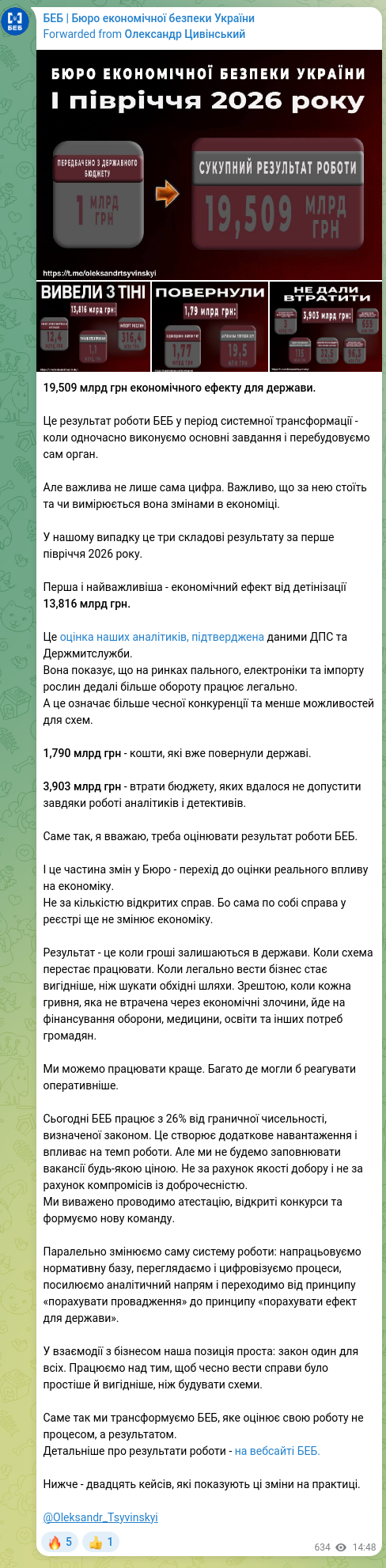
19,509 billion UAH of economic impact for the state.
This is the result of the SBU's Economic Security Bureau's work during a period of systemic transformation — when we are both carrying out core tasks and rebuilding the agency itself.
But the figure alone isn't the only important thing. What matters is what it represents and whether it is measured by changes in the economy.
In our case, these are three components of the result for the first half of 2026 year.
The first and most important is the economic effect from de-shadowing: 13,816 billion UAH.
This is our analysts' estimate, confirmed by data from the State Tax Service and the State Customs Service.
It shows that in the fuel, electronics, and plant imports markets, an increasing share of turnover is operating legally.
That means more fair competition and fewer opportunities for schemes.
1,790 billion UAH — funds that have already been returned to the state.
3,903 billion UAH — budget losses that were prevented thanks to the work of analysts and detectives.
This, I believe, is how the Economic Security Bureau's results should be evaluated.
And this is part of the changes in the Bureau — a shift toward assessing real impact on the economy.
Not by the number of opened cases. Because a case listed in the registry by itself does not change the economy.
The result is when money stays with the state. When a scheme stops working. When conducting business legally becomes more profitable than seeking workarounds. Ultimately, when every hryvnia not lost to economic crimes goes to funding defense, healthcare, education, and other citizen needs.
We can work better. In many areas we could have responded more quickly.
Today the Bureau operates at 26% of the statutory headcount. This creates additional burden and affects the pace of work. But we will not fill vacancies at any cost. Not at the expense of recruitment quality and not at the expense of compromises with integrity.
We are conducting balanced attestations, open competitions, and building a new team.
At the same time, we are changing the system itself: developing the regulatory framework, reviewing and digitizing processes, strengthening the analytical direction, and shifting from the principle of “count the proceedings” to the principle of “count the effect for the state.”
In our interaction with business our position is simple: the law is the same for everyone. We are working to make honest business easier and more profitable than building schemes.
This is how we are transforming the Bureau to evaluate its work not by process but by outcome.
More about the results of the work is on the Bureau's website.
Below are twenty cases that demonstrate these changes in practice.
@Oleksandr_Tsyvinskyi