 Back
Back

Automatically translated version. May contain inaccuracies compared to the original.
STATEMENT OF THE OFFICE OF THE ATTORNEY GENERAL REGARDING NIGHTTIME SEARCHES
The Office of the Attorney General considers it important to separate two issues that are being discussed in the public sphere today.
The first is the investigation of the possible involvement of one of the OAG employees in unlawful activities related to the operation of fraudulent call centers.
The second is the searches carried out at night in the office premises of the Attorney General, the First Deputy Attorney General, and other OAG employees, during which NABU detectives gained access to materials from other criminal proceedings.
Regarding the first issue, the Attorney General’s position is unequivocal.
Using one’s position, status as a prosecutor, or official resources to cover up or facilitate any criminal activity is unacceptable and will be punished with liability provided by law.
With respect to the OAG employee mentioned in the NABU investigation, the issue of his dismissal from the prosecution service is currently being decided.
The Office of the Attorney General, for its part, will provide the investigation with the necessary assistance and the information required by law.
At the same time, the same strict observance of the law, procedural guarantees, and the limits of judicial authorizations must be ensured by all law enforcement agencies.
Around midnight, NABU detectives nevertheless conducted investigative actions in the office premises used by the Attorney General, the First Deputy Attorney General, as well as other employees and structural units of the OAG.
The scale of these investigative actions, their factual justification, and the list of materials to which access was obtained require a separate legal assessment.
Among the documents accessed during the searches were materials of a criminal proceeding concerning possible unlawful acts by close persons associated with the leadership of the SAP. That proceeding was being investigated under the procedural supervision of the Office of the Attorney General. The SAP leadership was aware of its existence and the course of the investigation.
In addition, detectives gained access to materials of another criminal proceeding, in particular information obtained during covert investigative actions regarding possible unlawful activities of NABU and SAP employees.
Under these circumstances, the OAG considers it necessary to establish whether the actual scope of the detectives’ access corresponded to the subject matter of the criminal proceeding within which the searches were conducted.
This concerns exclusively the legal assessment of specific procedural actions: which materials were accessed, whether they were inspected, copied, or seized, and whether they were covered by the relevant judicial authorizations.
Separate questions also arise after analyzing the court rulings that were used to justify the investigative actions concerning the OAG leadership.
Regarding the Attorney General
The ruling cites certain conversations of an OAG employee that relate to household matters.
These include a mention of “dark tiles” in one of the premises used by the Attorney General, as well as discussion about installing an alarm system and interior sensors.
On the basis of these conversations, the materials subsequently put forward a version about a possible connection to funds that, according to the investigation’s assumptions, could have had unlawful origin.
At the same time, the materials cited in the ruling contain no direct data that the Attorney General gave any instructions to facilitate the call centers’ activities, obstruct their exposure or investigation, warned anyone about planned investigative actions, received funds from such activities or illicit benefits, or paid for repair works, installation of an alarm system, or any other services from money of criminal origin.
The link between the cited household conversations and possible criminal activity in the materials is substantiated mainly by assumptions.
This is evidenced by the formulations used in the ruling: “likely,” “possible awareness,” “does not exclude,” “may be.”
That is why, in our opinion, the sufficiency of such data to carry out investigative actions in the Attorney General’s office premises requires a separate assessment.
Another example is Order No. 309 “On organizing the activities of prosecutors in a criminal proceeding.”

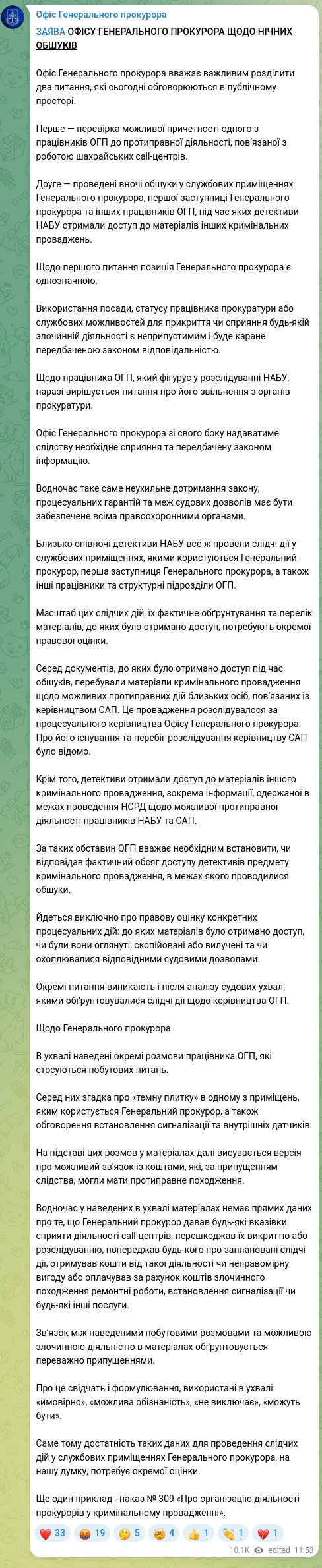






 Telegram publication