
 Back
Back
Automatically translated version. May contain inaccuracies compared to the original.
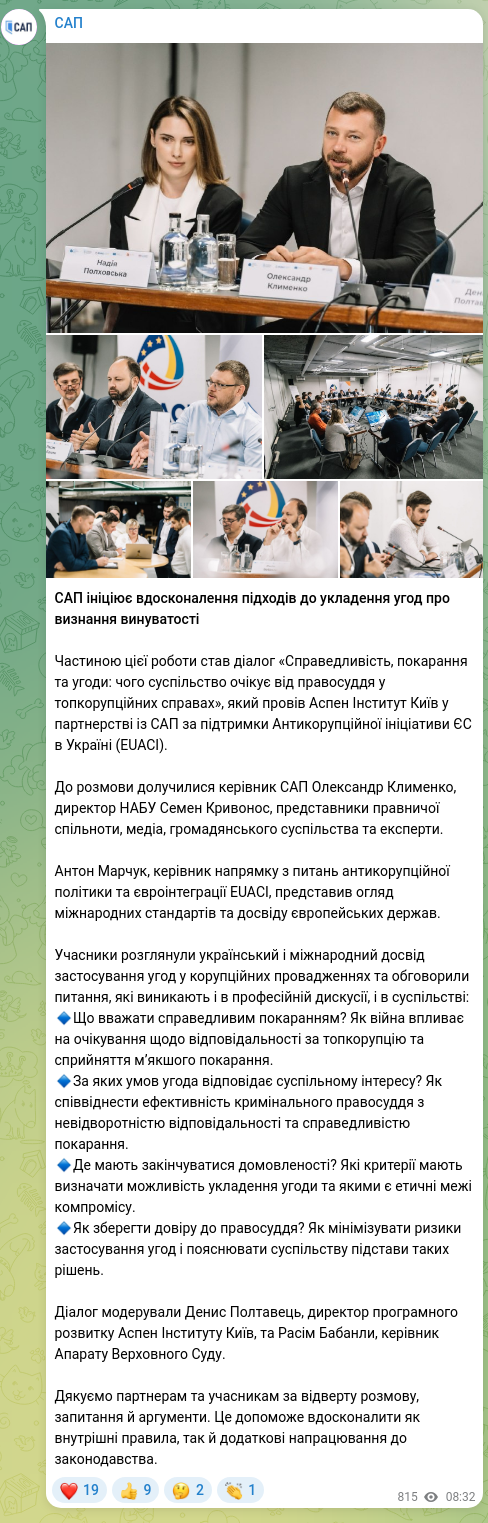
The SAP is initiating improvements to approaches for concluding plea agreements
Part of this work was the dialogue “Justice, Punishment, and Agreements: What Society Expects from Justice in High-Level Corruption Cases,” which Aspen Institute Kyiv held in partnership with the SAP with support from the EU Anti-Corruption Initiative in Ukraine (EUACI).
The conversation included SAP Head Oleksandr Klymenko, NABU Director Semen Kryvonos, representatives of the legal community, media, civil society, and experts.
Anton Marchuk, head of the anti-corruption policy and European integration unit at EUACI, presented an overview of international standards and the experience of European countries.
Participants examined Ukrainian and international experience in using agreements in corruption proceedings and discussed questions that arise both in professional debate and in society:
🔹What should be considered a just punishment? How does the war affect expectations about accountability for high-level corruption and perceptions of more lenient penalties.
🔹Under what conditions does an agreement serve the public interest? How can the effectiveness of criminal justice be reconciled with the inevitability of accountability and the fairness of punishment.
🔹Where should agreements draw the line? What criteria should determine the possibility of concluding an agreement, and what are the ethical limits of compromise.
🔹How can trust in the justice system be preserved? How can the risks of using agreements be minimized and the reasons for such decisions be explained to the public.
The dialogue was moderated by Denys Poltavets, director of program development at Aspen Institute Kyiv, and Rasim Babanly, head of the Office of the Supreme Court.
We thank the partners and participants for the candid conversation, questions, and arguments. This will help improve both internal rules and additional legislative work.






 Telegram publication