Back
Back

Automatically translated version. May contain inaccuracies compared to the original.
When a private conversation becomes a crime: a bitter lesson from the Supreme Court ⚖️
In June 2026 the Criminal Cassation Court upheld a sentence against a man: 5 years imprisonment for inciting national enmity, humiliating national honor and dignity (art. 161 of the Criminal Code) and for justifying Russia’s aggression (art. 436-2 of the Criminal Code).
But the most interesting thing in this case is the separate opinion of judge Arkadii Petrovych Bushchenko, which sounds the alarm about human rights standards.
https://reyestr.court.gov.ua/Review/137457530
Mr. Arkadii’s human rights work is well known, as he worked for many years with the Kharkiv Human Rights Group and the Ukrainian Helsinki Human Rights Union. His uncompromising character is vividly illustrated by the incident when he publicly returned the DEJURE foundation🤡 their “Honor of the Week” award, sharply expressing everything he thought about their prize.
📌 Main theses of the judge’s separate opinion:
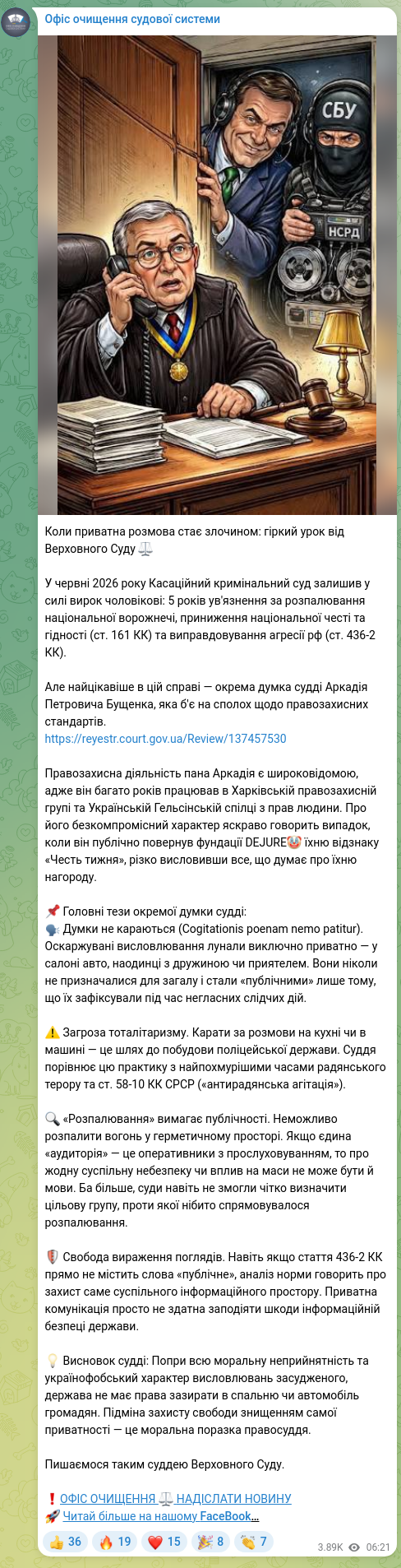
🗣 Thoughts are not punishable (Cogitationis poenam nemo patitur). The contested statements were made exclusively in private — in the car’s cabin, alone with his wife or a friend. They were never intended for the public and became “public” only because they were recorded during covert investigative actions.
⚠️ The threat of totalitarianism. Punishing people for conversations in the kitchen or in the car is the road to building a police state. The judge compares this practice to the darkest times of Soviet terror and to art. 58-10 of the USSR Criminal Code (“anti-Soviet agitation”).
🔍 “Incitement” requires publicity. You cannot kindle a fire in a sealed space. If the only “audience” is surveillance operatives, then there can be no question of any public danger or influence on the masses. Moreover, the courts could not even clearly identify the target group that the alleged incitement was aimed at.
🛡 Freedom of expression. Even if articles 436-2 of the Criminal Code do not explicitly contain the word “public,” analysis of the norm points to protection of the public informational sphere. Private communication simply cannot harm the state’s information security.
💡 The judge’s conclusion: Despite the utter moral unacceptability and the Ukrainophobic nature of the convicted person’s statements, the state has no right to peer into citizens’ bedrooms or cars. Replacing the protection of freedom with the destruction of privacy itself is a moral defeat for justice.
We are proud of such a Supreme Court judge.
❗️OFFICE OF PURIFICATION ⚖️ SEND NEWS
🚀 Read more on our FaceBook…






 Telegram publication