Back
Back

Automatically translated version. May contain inaccuracies compared to the original.
18 September 2026, Acting Prosecutor General Anton Kovalsky held a meeting with the heads of structural units of the OPG and regional prosecutor’s offices, during which the leaders were “instructed to refrain from making decisions on appointing prosecutors pursuant to the transitional provisions of the Law of Ukraine ‘On the Prosecutor’s Office.’”
The corresponding announcement was published by the OPG.
The possibility of appointing prosecutors to the OPG and regional prosecutor’s offices without holding a competition was introduced by Law No. 4555-IX of 22 July 2025.
It was this Law that supplemented Section XIII “Transitional Provisions” of the Law of Ukraine “On the Prosecutor’s Office” with paragraph 5-4, according to which, during martial law, a prosecutor of the OPG or a regional prosecutor’s office may be appointed a prosecutor from a lower-level prosecutor’s office by transfer without holding the competition provided for in Article 38 of the Law, and also, under the conditions established by law, a person who previously did not hold the position of prosecutor.
Importantly, this provision was adopted by the same Law that introduced high-profile changes to the powers of the Prosecutor General regarding NABU and the SAP.
Already on 31 July 2025, Law No. 4560-IX revised the corresponding provisions regarding NABU and the SAP.
At the same time, paragraph 5-4 of Section XIII of the Law “On the Prosecutor’s Office” was not repealed or amended and remains part of the current version of the Law.
Thus, as of today paragraph 5-4 is an operative legal provision, the application of which is expressly provided for during the period of martial law.
Therefore, I believe that the start of the new Acting Prosecutor General’s work with an instruction that is effectively aimed at the general non-application of a mechanism expressly provided for by law is, at minimum, a questionable managerial practice and a dangerous precedent for a body whose activity must be based primarily on the principle of legality.
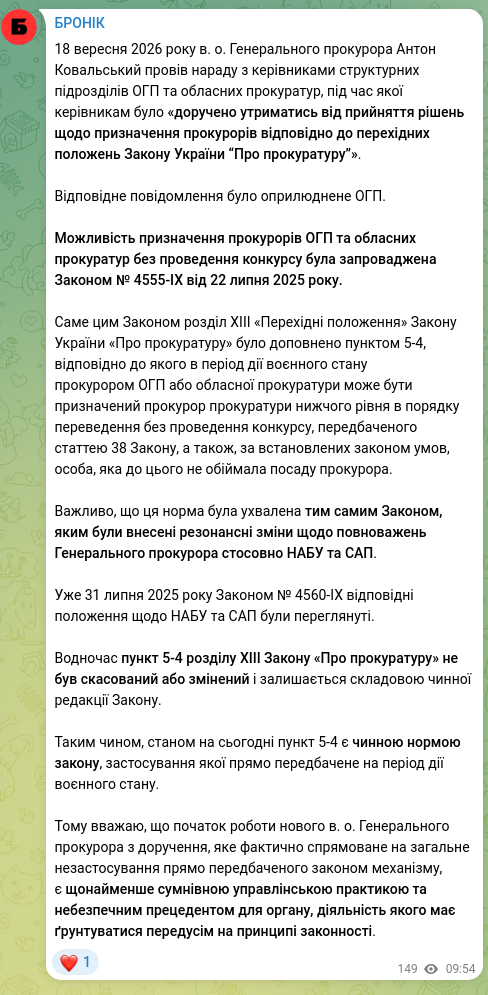






 Telegram publication