Back
Back
Automatically translated version. May contain inaccuracies compared to the original.
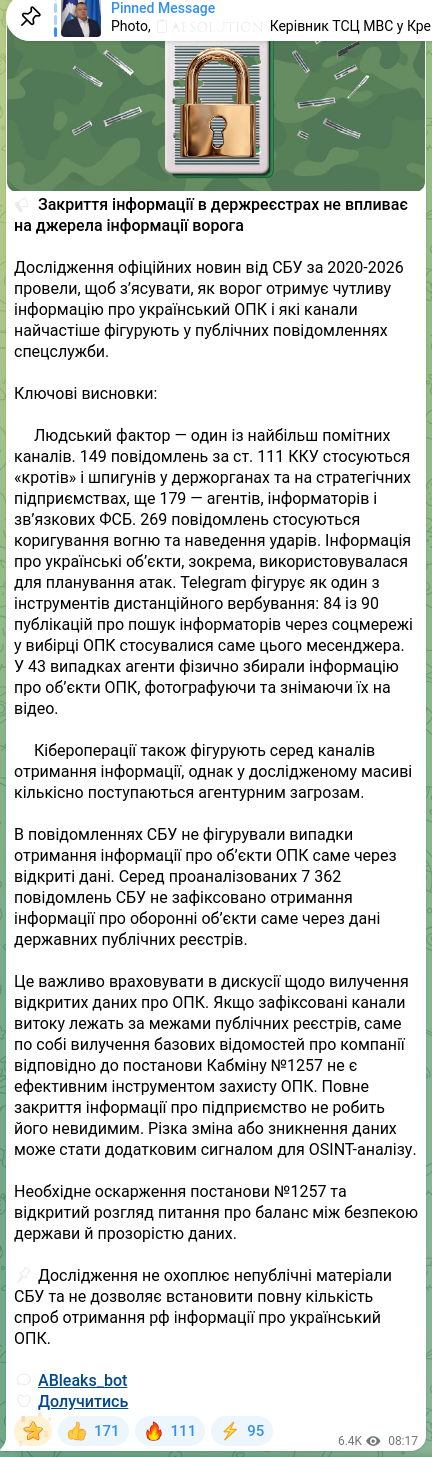
🔈 Closing information in state registers does not affect the enemy’s sources of information
A study of official news from the SBU for 2020–2026 was conducted to determine how the enemy obtains sensitive information about Ukraine’s defense-industrial complex and which channels most often appear in the security service’s public reports.
Key findings:
🔸The human factor is one of the most visible channels. 149 of reports under Art. 111 of the Criminal Code relate to “moles” and spies in state bodies and at strategic enterprises, another 179 concern agents, informants, and FSB couriers. 269 of reports concern fire adjustment and guiding strikes. Information about Ukrainian facilities was, in particular, used to plan attacks. Telegram appears as one of the tools for remote recruitment: 84 of 90 publications about searching for informants via social networks in the defense-industrial sample referred specifically to this messenger. In 43 cases agents physically collected information about defense-industrial facilities by photographing and filming them.
🔸Cyber operations also appear among the channels for obtaining information, however in the examined dataset they are numerically outnumbered by agent threats.
The SBU’s reports did not include cases of obtaining information about defense-industrial facilities specifically through open data. Among the analyzed 7 362 SBU reports, no instances were recorded of information about defense facilities being obtained specifically through data from state public registers.
This should be taken into account in the discussion about removing open data on the defense-industrial complex. If the recorded leakage channels lie outside public registers, removing basic company information pursuant to Cabinet resolution No. 1257 by itself is not an effective tool for protecting the defense-industrial complex. Completely closing information about an enterprise does not make it invisible. A sharp change or disappearance of data can become an additional signal for OSINT analysis.
It is necessary to challenge resolution No. 1257 and openly discuss the balance between state security and data transparency.
📌 The study does not cover non-public SBU materials and does not allow establishing the full number of attempts by the Russian Federation to obtain information about Ukraine’s defense-industrial complex.
💬 ABleaks_bot
💕 Join






 Telegram publication