Back
Back

Automatically translated version. May contain inaccuracies compared to the original.
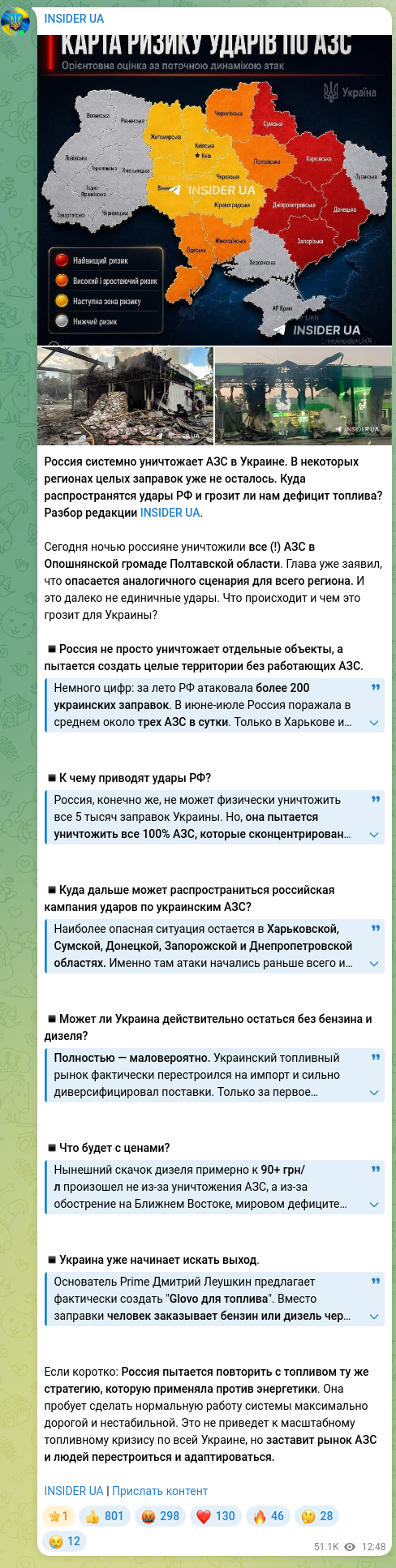
Russia is systematically destroying gas stations in Ukraine. In some regions entire filling stations are already gone. Where will Russia’s strikes spread and do we face a fuel shortage? Analysis by the INSIDER UA editorial team.
Last night the Russians destroyed all (!) gas stations in the Oposhnya community of Poltava region. The head of the community has already said he fears a similar scenario for the entire region. And these are far from isolated strikes. What is happening and what does it mean for Ukraine?
▪️Russia is not just destroying individual sites, it is trying to create whole territories without functioning gas stations.
A few numbers: over the summer Russia attacked more than 200 Ukrainian filling stations. In June–July Russia was hitting on average about three gas stations per day. Only in Kharkiv and the region more than 80 gas stations have been destroyed. In Zaporizhzhia over 24 days there were 54 recorded strikes on gas stations. Back in June after a series of strikes in Trostianets there were no intact permanent gas stations left at all, and by the end of July all filling stations were destroyed along roughly a 150-kilometer section of the highway between Kharkiv and Poltava.
▪️What do Russia’s strikes lead to?
Russia, of course, cannot physically destroy all 5 thousand gas stations in Ukraine. But it is trying to destroy all 100% of the gas stations that are concentrated in a single area. That is practically a local fuel collapse. People have to drive tens of kilometers to the nearest working station, the load on neighboring stations rises sharply, fuel delivery becomes more expensive, it becomes harder for businesses to organize transport, and the stations themselves refuse to operate around the clock because of the strikes. That is the kind of effect Russia now seems to be trying to scale up.
▪️Where might Russia’s campaign of strikes on Ukrainian gas stations spread next?
The most dangerous situation remains in Kharkiv, Sumy, Donetsk, Zaporizhzhia, and Dnipropetrovsk regions. Those are where the attacks began first and are occurring most systematically. But since June the geography has sharply expanded: gas stations in Poltava, Chernihiv, Mykolaiv, Odesa regions and near Kyiv have already been hit. The threat could also spread to Kyiv, Zhytomyr, and other more rear areas.
▪️Could Ukraine really run out of gasoline and diesel?
Completely—unlikely. The Ukrainian fuel market has in effect shifted to imports and greatly diversified supplies. In the first half of 2026 the year Ukraine imported more than 3 million tons of diesel—12% more than a year earlier, and in July it brought in 196 thousand tons of gasoline—the largest monthly volume in almost a year. So gasoline will be available in Ukraine, but Russia can destroy the place where you usually buy it.
The only major problem is logistics. Especially the southern route. Because of low water levels on the Danube, water delivery options are shrinking, and queues at the border are already measured in days. Therefore, if possible, it’s better to keep a reserve of 10–15 liters at home.
▪️What will happen to prices?
The current spike in diesel to about 90+ UAH/l did not happen because of destroyed gas stations, but because of the escalation in the Middle East, a global diesel shortage, etc. Prices constantly rise and fall. However, a jump to 100 UAH/l nationwide is unlikely right now.
But if the attacks continue for several more months, a large price difference for fuel between regions may appear (not 100 UAH across the country, but cheaper in the west, more expensive in the east) and an additional delivery cost to areas where a significant part of the network was destroyed.
▪️Ukraine is already starting to look for solutions.
Prime founder Dmytro Leushkin proposes effectively creating a “Glovo for fuel.” Instead of going to a station, a person orders gasoline or diesel via an app or chat-bot, after which a specialized vehicle arrives and refuels the car. Another option is mobile gas stations that constantly change location and are therefore much harder to turn into a permanent target.
In short: Russia is trying to repeat with fuel the same strategy it used against the power sector. It is trying to make normal functioning of the system as expensive and unstable as possible. This will not lead to a nationwide fuel crisis across all of Ukraine, but it will force the gas station market and people to restructure and adapt.
INSIDER UA | Send content