Back
Original version

One of NABU’s detectives writes on his Facebook that the Mudra/Mykytaś/Stolar case has raised an important question abou...

Automatically translated version. May contain inaccuracies compared to the original.

One of NABU’s detectives writes on his Facebook that the Mudra/Mykytaś/Stolar case has raised an important question about bail.

In particular, the detective wrote: “as practice shows, in some cases bail has ceased to be a preventive measure and has itself become an element of the criminal economy.”

Using the “Midas” case as an example, the detective notes:

“Tens and hundreds of millions of hryvnias are posted as bail for top officials from the accounts of companies that formally have nothing to do with these people. These are unknown firms with dubious business activities. Their founders and directors often cannot explain either what their companies actually do or why they suddenly decided to post millions of hryvnias in bail for the suspects. They cannot, because behind the screens of such front people stand other individuals — the real beneficiaries of these companies. People who do not want their involvement to become known.”

“The source of the funds is cash accumulated as a result of unlawful activity. For the needs of the suspect it is effectively exchanged for non-cash funds that are already on the companies’ accounts. After that the company formally acts as the pledgor and transfers the money to the appropriate account,” the detective writes.

In the “MIDAS” case the fees for such a service varied: “We received information about 10%, 15% and even 30% of the bail amount. That is, this is no longer simply a way to help a particular suspect. It is also a rather profitable business.”

The detective is outraged that financial monitoring — one of whose key tasks is to counter the legalization of proceeds from crime — should have worked.

“But in practice it works differently — the money is transferred, bail is posted, and the suspects are released.

And then bail effectively becomes payment for silence.”

“Expenses of the criminal milieu to preserve itself.”

“Today they posted bail and released a person who, according to the investigation, received millions of dollars in bribes.”

“Tomorrow — they will help them evade court‑imposed duties, leave the country, and live their better life somewhere abroad.”

“And bail turns out to be a cashback for the state.”

After this, the NABU detective concludes that the rules for determining bail and the procedure for posting it require immediate legislative changes.

In his view, draft law No. 15388 of 8 July 2026 could “be a good basis for such changes.”

“The state must check a company that suddenly decides to post tens of millions of hryvnias in bail for a suspect.

Who is its real owner? Where did it get these funds? What relationship links the pledgor to the suspect? And most importantly — do these funds have a lawful origin?”

“These questions must be answered before the money performs its function and the remand prison doors open.”

“Bail must remain an effective preventive measure, not cashback from stolen assets.”

We fully agree; all these issues must be resolved quickly. But there are three other important questions:

- Why has this issue arisen only now? This scheme has existed for ten years.

- The rules for setting exorbitant bail amounts and the subsequent logic of their reduction.

- The end of the shameful practice of publishing documents and information unrelated to the criminal proceedings against a person (especially before determining the type of preventive measure) and bringing those who violate this rule to account.
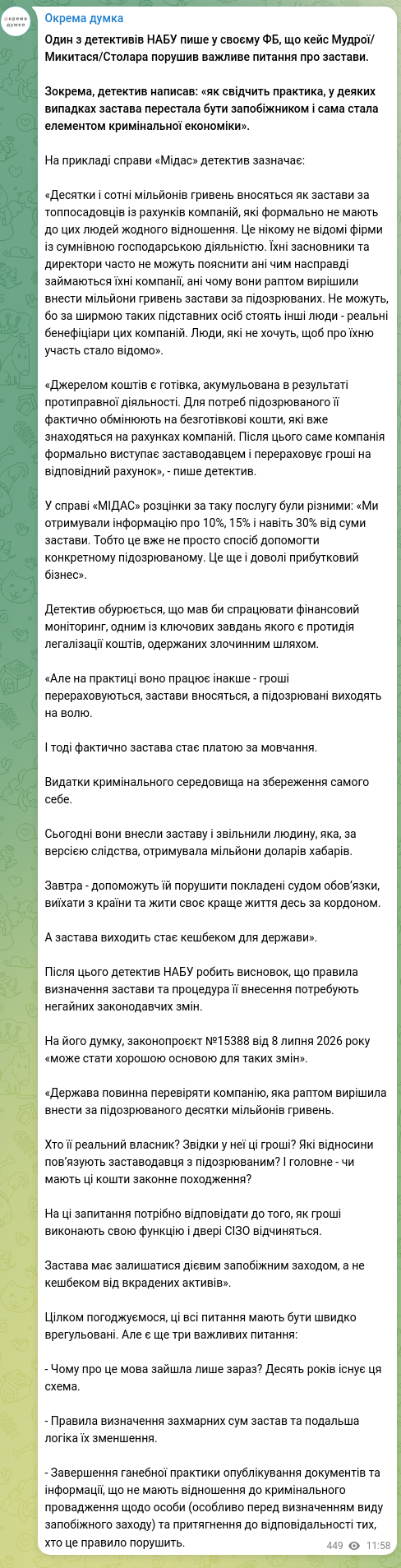
Screenshot of a Telegram post: One of NABU’s detectives writes on his Facebook that the Mudra/Mykytaś/Stolar c…

Один з детективів НАБУ пише у своєму ФБ, що кейс Мудрої/Микитася/Столара порушив важливе питання про застави.

Зокрема, детектив написав: «як свідчить практика, у деяких випадках застава перестала бути запобіжником і сама стала елементом кримінальної економіки».

На прикладі справи «Мідас» детектив зазначає:

«Десятки і сотні мільйонів гривень вносяться як застави за топпосадовців із рахунків компаній, які формально не мають до цих людей жодного відношення. Це нікому не відомі фірми із сумнівною господарською діяльністю. Їхні засновники та директори часто не можуть пояснити ані чим насправді займаються їхні компанії, ані чому вони раптом вирішили внести мільйони гривень застави за підозрюваних. Не можуть, бо за ширмою таких підставних осіб стоять інші люди - реальні бенефіціари цих компаній. Люди, які не хочуть, щоб про їхню участь стало відомо».

«Джерелом коштів є готівка, акумульована в результаті протиправної діяльності. Для потреб підозрюваного її фактично обмінюють на безготівкові кошти, які вже знаходяться на рахунках компаній. Після цього саме компанія формально виступає заставодавцем і перераховує гроші на відповідний рахунок», - пише детектив.

У справі «МІДАС» розцінки за таку послугу були різними: «Ми отримували інформацію про 10%, 15% і навіть 30% від суми застави. Тобто це вже не просто спосіб допомогти конкретному підозрюваному. Це ще і доволі прибутковий бізнес».

Детектив обурюється, що мав би спрацювати фінансовий моніторинг, одним із ключових завдань якого є протидія легалізації коштів, одержаних злочинним шляхом.

«Але на практиці воно працює інакше - гроші перераховуються, застави вносяться, а підозрювані виходять на волю.

І тоді фактично застава стає платою за мовчання.

Видатки кримінального середовища на збереження самого себе.

Сьогодні вони внесли заставу і звільнили людину, яка, за версією слідства, отримувала мільйони доларів хабарів.

Завтра - допоможуть їй порушити покладені судом обов’язки, виїхати з країни та жити своє краще життя десь за кордоном.

А застава виходить стає кешбеком для держави».

Після цього детектив НАБУ робить висновок, що правила визначення застави та процедура її внесення потребують негайних законодавчих змін.

На його думку, законопроєкт №15388 від 8 липня 2026 року «може стати хорошою основою для таких змін».

«Держава повинна перевіряти компанію, яка раптом вирішила внести за підозрюваного десятки мільйонів гривень.

Хто її реальний власник? Звідки у неї ці гроші? Які відносини пов’язують заставодавця з підозрюваним? І головне - чи мають ці кошти законне походження?

На ці запитання потрібно відповідати до того, як гроші виконають свою функцію і двері СІЗО відчиняться.

Застава має залишатися дієвим запобіжним заходом, а не кешбеком від вкрадених активів».

Цілком погоджуємося, ці всі питання мають бути швидко врегульовані. Але є ще три важливих питання:

- Чому про це мова зайшла лише зараз? Десять років існує ця схема.

- Правила визначення захмарних сум застав та подальша логіка їх зменшення.

- Завершення ганебної практики опублікування документів та інформації, що не мають відношення до кримінального провадження щодо особи (особливо перед визначенням виду запобіжного заходу) та притягнення до відповідальності тих, хто це правило порушить.

Screenshot of a Telegram post: Один з детективів НАБУ пише у своєму ФБ, що кейс Мудрої/Микитася/Столара поруши…
Download Download proof

Other channel publications